Graza Marketing Strategy: The Bottle Was Only the Hook
Graza marketing strategy, from a chef's objection to 28,000 stores: the squeeze bottle got noticed, but seeding, launch order, and names built it.
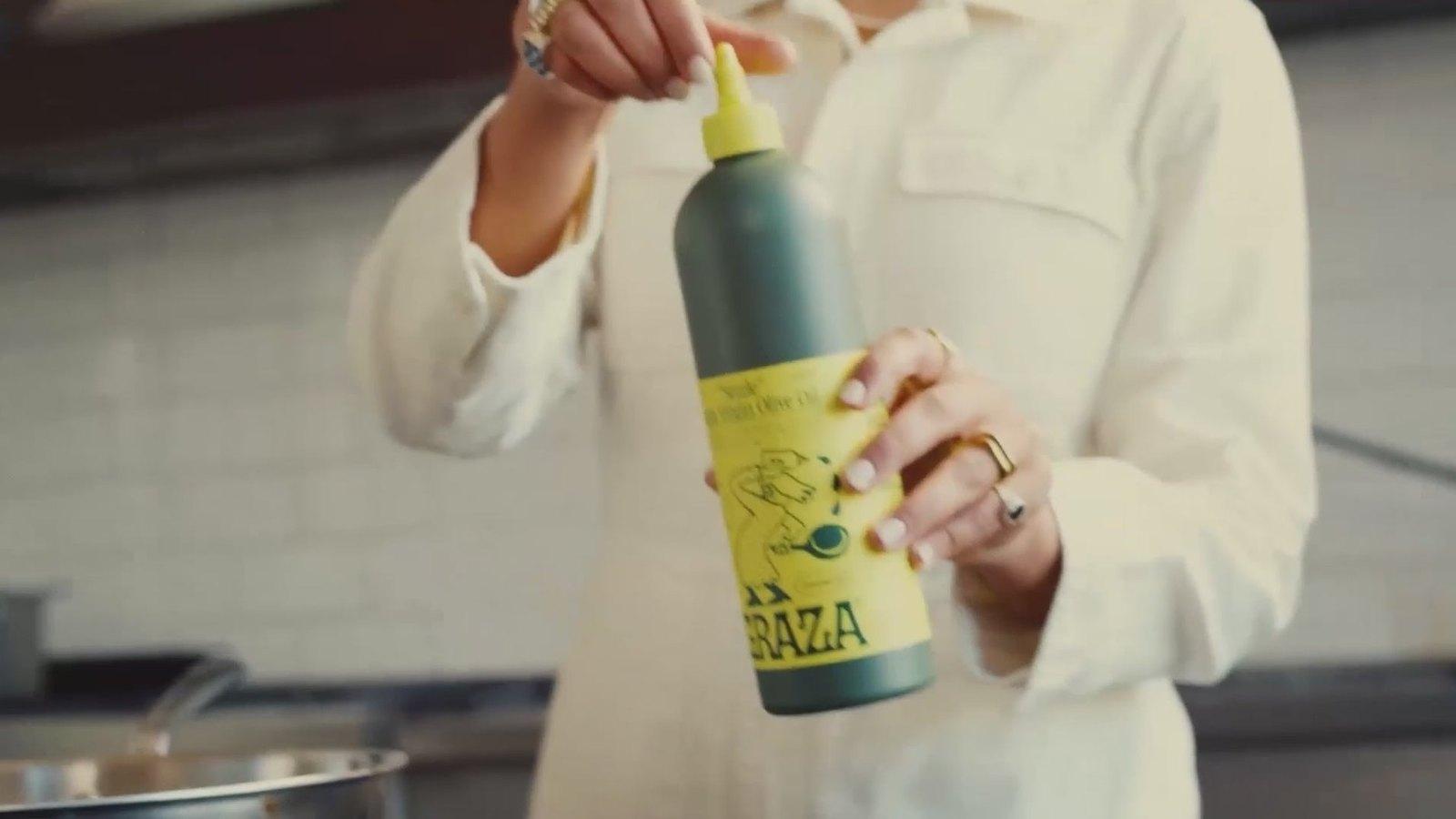
Graza sold $100,000 of olive oil in its first week without running a single paid ad, then took four years and more than 28,000 stores to get to its biggest paid campaign. Most breakdowns of Graza's marketing strategy credit the green squeeze bottle. The bottle earned the first look, but the part other marketers can reuse is the sequence behind it: seed the product before you sell it, prove demand online before you pitch retail, and hold paid media until there is something worth scaling.
The short version
- The positioning came from an objection. A chef told the founder the world needed good olive oil for everyone, and that one line set Graza's price and its everyday tone.
- Seeding came before selling. Creators and shop owners got free oil weeks before launch, with no posting requirement.
- Retail came after proof. Whole Foods reached out after an online sellout, and the largest paid campaign arrived four years later.
- The names outlasted the bottle. Drizzle and Sizzle say what each oil is for, and a competitor can copy a bottle far more easily than a name.
Where did the idea for Graza come from?
Graza started as a road trip. Andrew Benin was living with his wife's family in Cádiz and between jobs when he borrowed his mother-in-law's Opel Corsa and drove four hours through olive groves from Córdoba to Jaén, a trip he describes on Graza's own blog. He came back with enough oil for a 10-oil tasting in the family's dining room, then flew home to Brooklyn with cases of it in his checked luggage.
Back in New York, he poured the oils for Michael Anthony, executive chef at Gramercy Tavern. Anthony didn't want another expensive, small-batch European import. "I really think what we need is this product, but for everyone," he told Benin, as Benin recounted to FoodNavigator in 2022. Benin and his co-founder, COO Allen Dushi, built the brand around a single-origin Picual oil from one supplier in Andalusia.
That objection became the positioning. Tasting Table's 2026 explainer describes the supermarket aisle as split between bottom-shelf bottles in the low teens or single digits and better brands that can run $30 or more. Graza aimed at the empty middle: an oil good enough for a chef, priced and packaged for a Tuesday night. Every decision that followed answers that brief.

Why did Graza put olive oil in a squeeze bottle?
The squeeze bottle gave Graza a format no other olive oil had on day one. "We own the molds," Benin told FoodNavigator, calling it "the first squeeze bottle brought to market in our category."
The bet behind it was usage, not looks. Benin told AIGA's Eye on Design in 2022 that the team wanted to raise "propensity of use because the form factor kind of does the work for us." For a consumable product, that is a growth lever most brands overlook. A bottle you can squeeze one-handed over a pan gets reached for more often, and oil that runs out sooner gets reordered sooner.
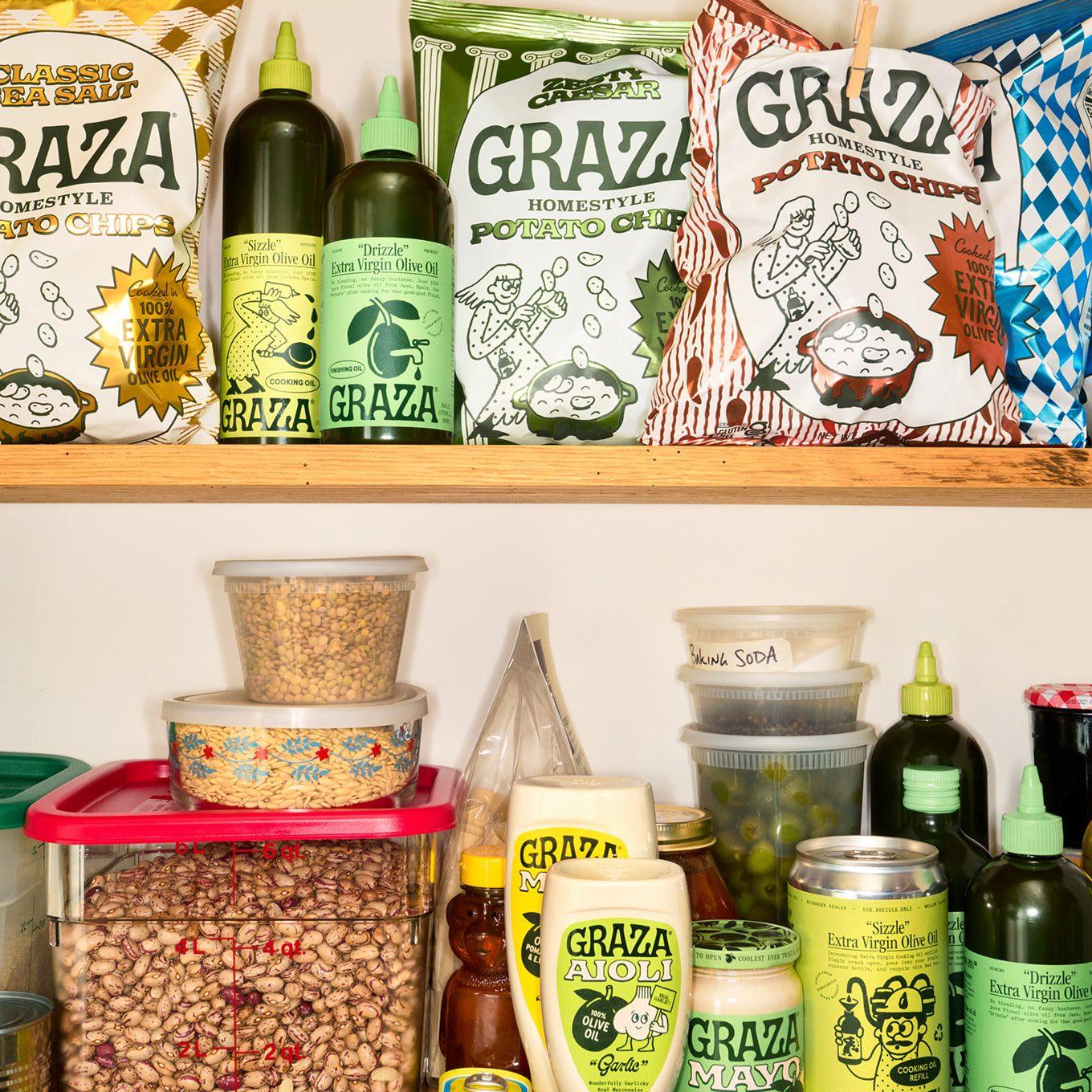
The format also solved a content problem. On a phone screen, a glass bottle glugs and a squeeze bottle draws a clean line, so every creator video showed the product working. Graza's pitch to creators, Marketing Brew reported, was one question: "How much easier would life be if olive oil came in a squeezy bottle?" Its own TikTok from June 2023 sells the squeeze and never mentions the olives.
When the package performs the benefit on camera, you don't have to explain it in the caption.
How Graza's branding makes olive oil feel everyday
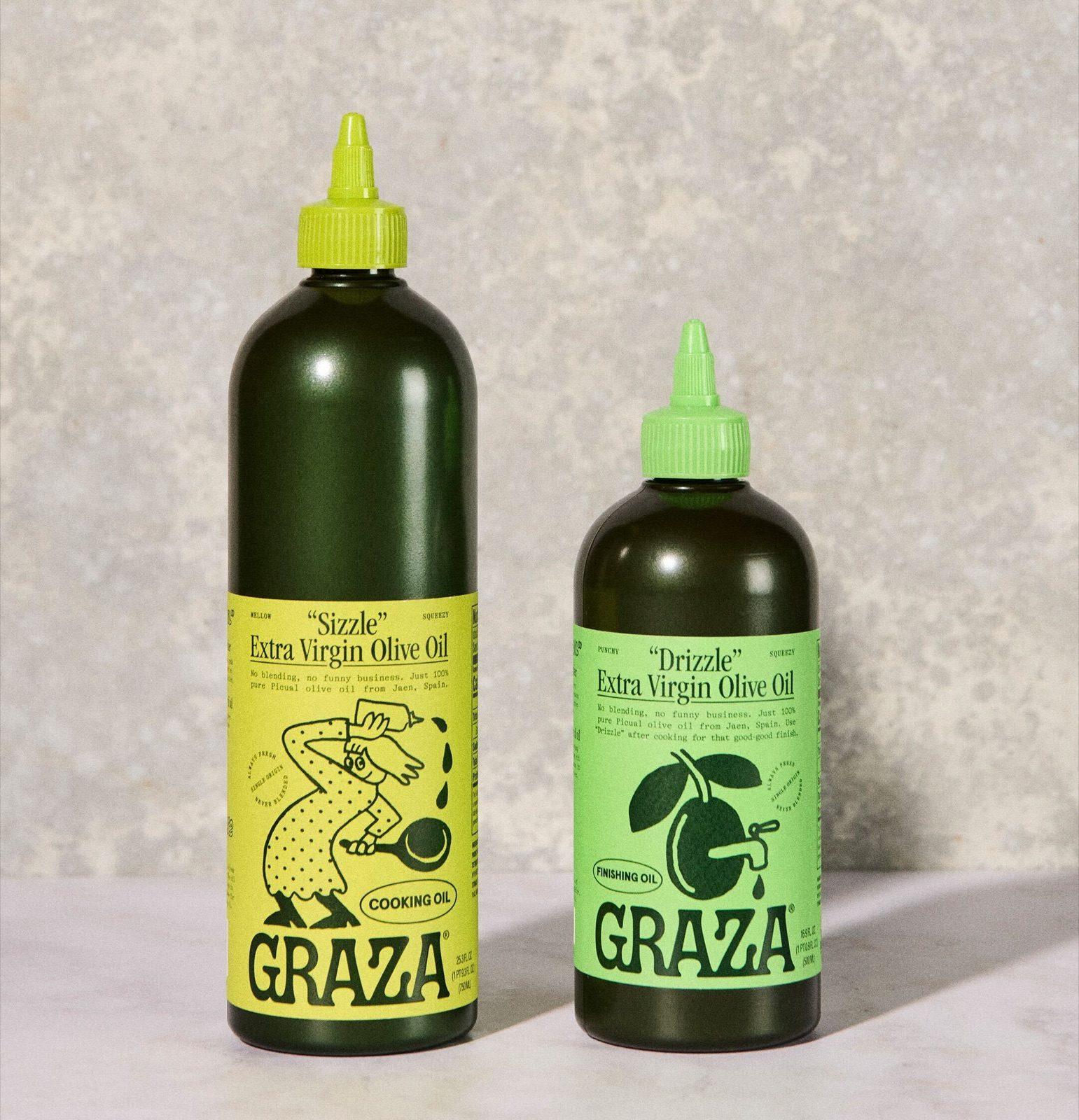
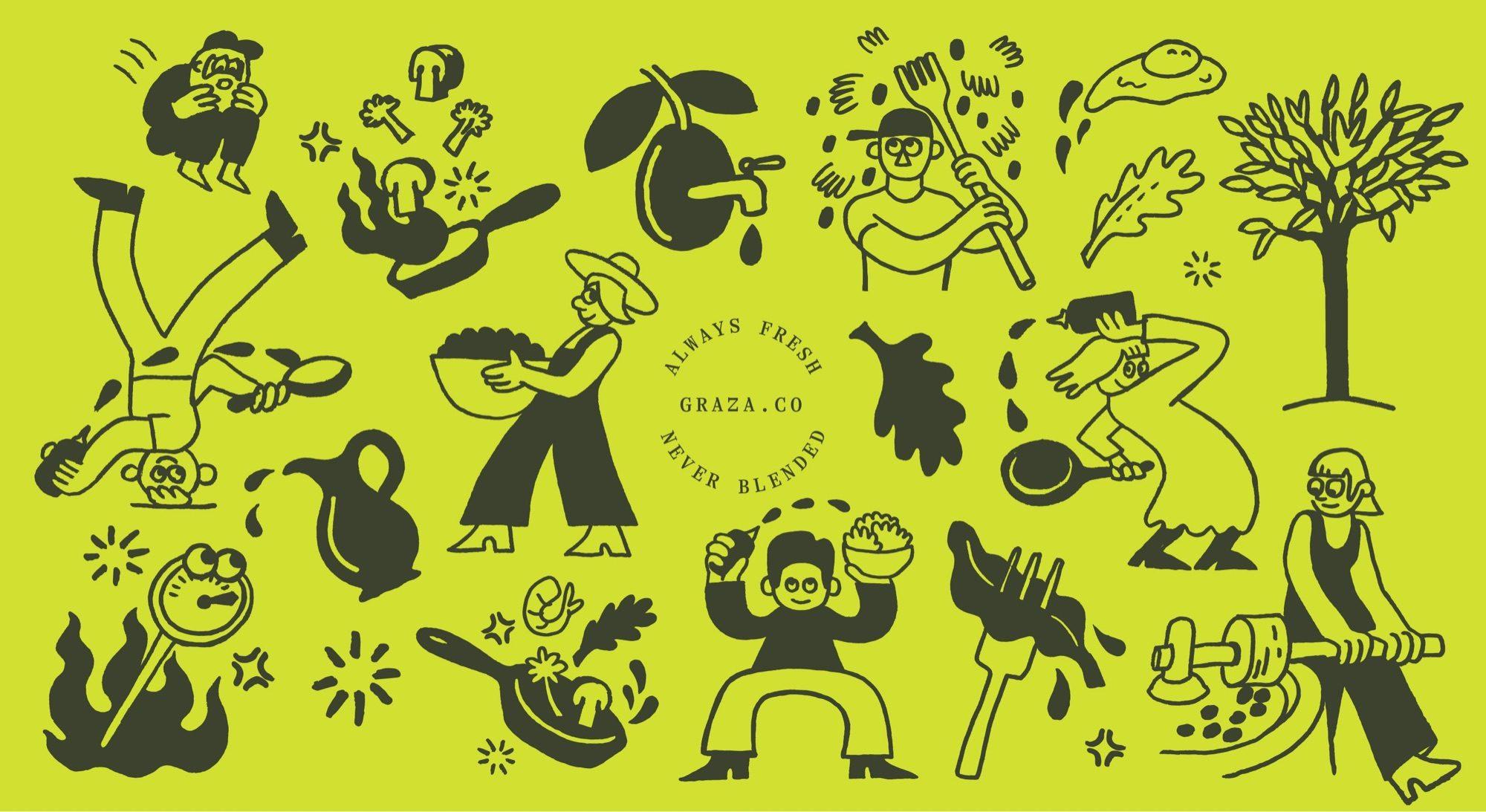
The bottle earned attention, and the label and names told people what kind of oil this was. Graza hired the New York agency Gander for the identity. Gander partner Katie Levy told AIGA that the type-led options were "beautiful, but missing the levity at the core of the brand," so the labels moved to hand-drawn illustrations: an olive with a spigot on Drizzle and a woman in a polka-dot dress squeezing oil into a pan on Sizzle. The drawings started as sketches "drawn with a Sharpie on a Post-It," and the goal was an oil that felt "very everyday," not saved for special occasions.
The names carry the same idea in words. Graza launched with two oils and put the job in each name: Drizzle, a 500 ml finishing oil, and Sizzle, a 750 ml cooking oil, per AIGA. FoodNavigator listed launch prices of $20 for the 16.9-ounce (500 ml) bottle and $15 for the 25.3-ounce (750 ml) bottle. Benin called Sizzle "your everyday cooking oil for breakfast, lunch, and dinner" and Graza "a non-heritage, non-luxury company."
Plain names lower the barrier to buying. A shopper doesn't need to know olive varieties to choose between cooking and finishing, and the system scales: by March 2025, Graza added Frizzle for high-heat cooking and sold all three on TikTok as "The Trio."
Of everything Graza built, the names have the longest shelf life. A competitor can order squeeze bottle molds, but a name like Sizzle on someone else's label reads as a copy on sight.
How did Graza become popular so fast?
Graza went live on its own website on January 11, 2022, Marketing Brew reported, and an audience was already waiting. A simple landing page had collected about 2,000 email addresses, and starting about three weeks out, the team mailed roughly 25 packs of oil a week to food creators with no posting requirement, according to a 2023 Klaviyo case study. Marketing Brew counted more than 100 packages sent before launch, with smaller creators getting oil weeks early and accounts with 200,000 or more followers getting it closer to launch day.
The list was built for curiosity, not reach. "We went after people that if you saw this on their account, people would want to ask about it," social media consultant Kendall Dickieson told Marketing Brew. That meant barbecue and pizza enthusiasts alongside high-level chefs, chosen to widen how people pictured using olive oil. Graza also sent samples to about 80 retailers, including pet stores and kids' toy stores, so shop owners got the same no-strings treatment as creators.
The payoff came in launch week. Cookbook author Molly Baz ran out of her gifted oil, Graza sent her 5-liter restaurant jugs as a refill, and she posted them. "The second she posted that on her story, it was a bloodbath," Benin told Klaviyo. Graza sold out in its first week with $100,000 in revenue and passed $500,000 by April, all without paid ads. Marketing Brew reported a 7.91% conversion rate on traffic from Graza's Instagram bio in the first seven days.
None of that was luck. Graza put an unfamiliar product in front of people whose followers would ask about it, then made it easy to buy when they did. For a founder-led version of the same playbook, see how Bloom Nutrition built its community.
Graza ran the grocery launch in reverse
Most packaged food brands buy their way onto the shelf. Slotting fees, the payments a retailer charges for shelf space, "can make up a large fraction of the revenues earned by some products in their first year," the FTC said in a 2003 release on its staff report.
Graza let the shelf come to it. After the online sellout, a Whole Foods representative reached out, and in June 2022 Graza announced it was launching in 116 Whole Foods stores across the Northeast and Southern Pacific. By the end of that year its bottles were on Whole Foods shelves nationwide, Inside Retail Asia reported in 2025. Target, Costco, and Walmart followed, and the same report estimated 2024 revenue at $48.4 million.
Paid media came last. By March 2026, Marketing Dive counted more than 28,000 retail locations and called Graza the fifth-largest olive oil brand in the U.S. That month Graza launched "Seriously Serious," its largest paid campaign to date, with TV spots and a "Top Chef" sponsorship, to sell a new olive oil mayo and garlic aioli.
| When | Move | Source |
|---|---|---|
| Three weeks before launch | About 25 packs a week to food creators, no posting required | Klaviyo, 2023 |
| January 11, 2022 | Online launch | Marketing Brew, 2022 |
| First week | Sold out with $100,000 in revenue | Klaviyo, 2023 |
| April 2022 | Passed $500,000 in revenue | Klaviyo, 2023 |
| June 2022 | Launch in 116 Whole Foods stores, Northeast and Southern Pacific | Graza release, 2022 |
| End of 2022 | On Whole Foods shelves nationwide | Inside Retail Asia, 2025 |
| End of 2023 | About 7,500 stores, projected | Modern Retail, 2023 |
| March 2026 | Largest paid campaign to date, 28,000+ locations | Marketing Dive, 2026 |
Each expensive step waited until the cheaper one before it had results. For a brand without a big launch budget, that order matters more than any single tactic.
What to take from Graza's marketing strategy
- Start from the objection. Anthony's "for everyone" set Graza's price and tone at once. Find the complaint your product answers before you design anything.
- Design the on-camera moment first. Decide what the product does in a 10-second video, then build the package around that action. Fishwife made the same packaging-first bet with its tins, which I break down in the Fishwife post.
- Seed for curiosity, not reach. Send product to creators and shops whose followers would ask about it, and skip the posting requirement.
- Prove demand online, then pitch retail. A sold-out first week is a stronger pitch to a buyer than a forecast, and it can save you the cost of buying shelf space.
- Name the job. A name that says what the product does is easy to choose from a shelf and stretches to new products.
The catch: the bottle stopped being Graza's alone
The weak point in the squeeze bottle story is that it didn't stay Graza's. California Olive Ranch launched a 500 ml squeezable "Chef's Bottle" in March 2024 after customers called asking for one, Modern Retail reported in April 2024, and Benin had earlier accused Brightland of copying the design on LinkedIn before apologizing. The same story quoted Kosterina founder Katina Mountanos: "Olive oil should never be packaged in plastic."
Graza then moved past the bottle itself. On August 7, 2025, it began selling Sizzle and Drizzle in glass, and Benin told The Dieline there had been "clear feedback from some people who simply prefer their Extra Virgin Olive Oil in glass." Costs pushed on the model too. Modern Retail reported in October 2023 that Graza was paying more than double its early 2022 import costs and had raised its price from $15 to $16 a bottle.
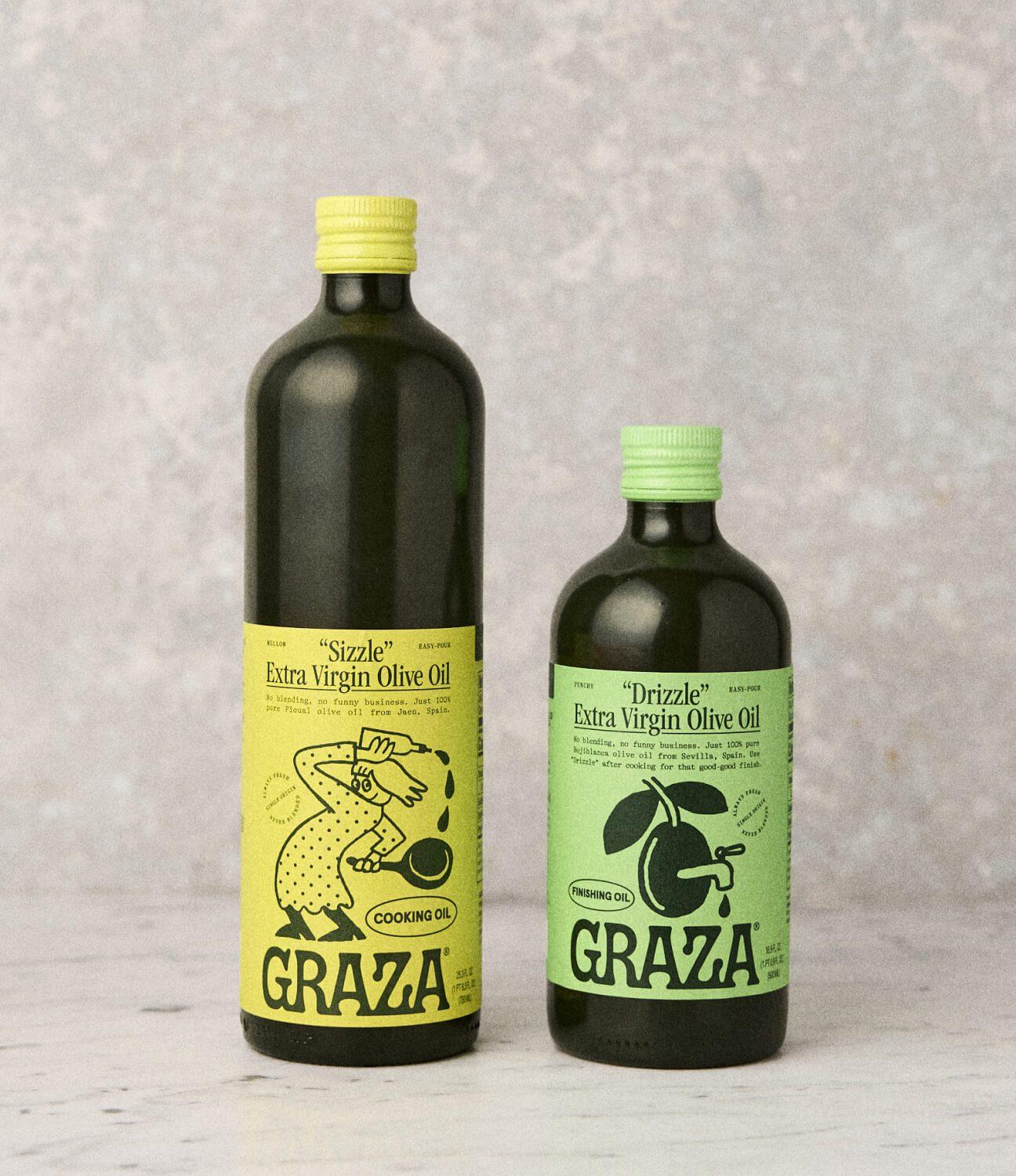
At 28,000 locations, most shoppers meet Graza on a shelf next to other squeeze bottles, so the name and label now do more of the selling than the shape. That makes the 2026 mayo launch the clearest read on the brand's strength. If shoppers buy Graza mayo, the brand lives in the names and the voice, and the bottle was the hook that got it started. If I were advising Graza, I'd have offered glass as a choice in year two, before critics could frame it as a concession.
A packaging hook lasts about as long as it takes a competitor to order molds. If you're launching something this year, test the hook and the name separately: post the product with no logo in frame and see whether people ask what it is, then put the name on a plain package and see whether people know what it's for. Graza needed both, and only one of them got harder to copy over time.

Written by Angel Phommachan, digital marketing specialist